· Music Theory · 4 min read
Modulation and Key Changes in Music Techniques, Examples, and Practice
Learn how modulation and key changes work in real music, from pivot chords and dominant preparation to abrupt modulations and creative applications.

Modulation and Key Changes in Music
Modulation is one of the most powerful tools in composition. It allows music to travel from one tonal center to another, creating contrast, emotional growth, and long-term interest.
Without modulation, many songs would feel repetitive, static, and predictable.
With it, music gains:
- Direction
- Narrative
- Emotional development
- Structural variety
In this guide, you’ll learn how modulation works, the main techniques, and how to apply them in real compositions.
1. What Is Modulation?
Modulation is the process of changing from one key (tonal center) to another within a musical piece.
It can be:
- Gradual
- Prepared
- Sudden
- Hidden
- Dramatic
A true modulation establishes a new tonic and makes it feel stable, not temporary.
Modulation vs. Tonicization
| Concept | Description |
|---|---|
| Tonicization | Temporary emphasis on a chord |
| Modulation | Permanent new key center |
Example:
C – D7 – G – C → Tonicization (G is temporary)
C – D7 – G – C – G – D – Em → Modulation (G becomes home)
If the music stays, it’s modulation.
If it visits and leaves, it’s tonicization.
2. Why Use Modulation?
Composers use modulation to:
- Avoid monotony
- Increase emotional impact
- Highlight important sections
- Extend musical form
- Create contrast
Emotional Effects
| Direction | Effect |
|---|---|
| Upward | Energy, brightness |
| Downward | Calm, darkness |
| Relative keys | Natural, smooth |
| Distant keys | Surprise, drama |
This is why “key change up a whole step” is a pop cliché. It works.
3. Main Types of Modulation
3.1 Diatonic Modulation
Diatonic modulation uses chords common to both keys.
These shared chords act as bridges.
Example: C → G
Shared chords:
- C
- Em
- G
- Am
Progression:
C – Am – Dm – G – D – G
Characteristics
- Very smooth
- Natural sounding
- Common in pop and folk
3.2 Pivot Chord Modulation
A pivot chord belongs to both keys but has different functions.
Example: C → F
| Chord | In C Major | In F Major |
|---|---|---|
| Dm | ii | vi |
Progression:
C – Dm – G – C C – Dm – Bb – F
Characteristics
- Invisible transition
- Strong tonal logic
- Classical and jazz favorite
3.3 Chromatic Modulation
Chromatic modulation introduces notes outside the key.
Usually via:
- Secondary dominants
- Diminished chords
- Altered dominants
Example: C → E
C – A7 – D7 – G7 – E
Characteristics
- High tension
- Dramatic effect
- Cinematic sound
3.4 Dominant-Based Modulation
This uses the dominant of the new key to force resolution.
Example: C → D
C – A7 – D
A7 is V of D, so D suddenly feels like home.
Characteristics
- Strong preparation
- Clear arrival
- Very effective
3.5 Abrupt Modulation (Direct Key Change)
No preparation. No warning. Just jump.
Example
Verse: C major Chorus: E major
Characteristics
- Shock effect
- High emotional impact
- Common in pop ballads
Used when subtlety is overrated.
4. Common Modulation Paths
Some key changes feel natural. Others feel extreme.
Closely Related Keys
| Relation | Example |
|---|---|
| Dominant | C → G |
| Subdominant | C → F |
| Relative minor | C → Am |
These are safe.
Distant Keys
| Relation | Example |
|---|---|
| Tritone | C → Gb |
| Major third | C → E |
| Minor third | C → Eb |
These are risky but powerful.
5. Functional Harmony and Modulation
Modulation works through functions.
Typical Path
Old Key: T – SD – D Pivot: D New Key: T – SD – D
Example:
C – F – G – D7 – G – C
The dominant acts as the gate.
6. Examples in Popular Music
| Type | Song | Keys |
|---|---|---|
| Diatonic | Somewhere Over the Rainbow | C → G |
| Chromatic | Bohemian Rhapsody | Bb → Eb |
| Pivot | Let It Be | C → G |
| Dominant | Hey Jude | F → G |
| Abrupt | Man in the Mirror | G → A |
Almost every famous song uses modulation somewhere. Coincidence? No.
7. Using the Circle of Fifths for Modulation
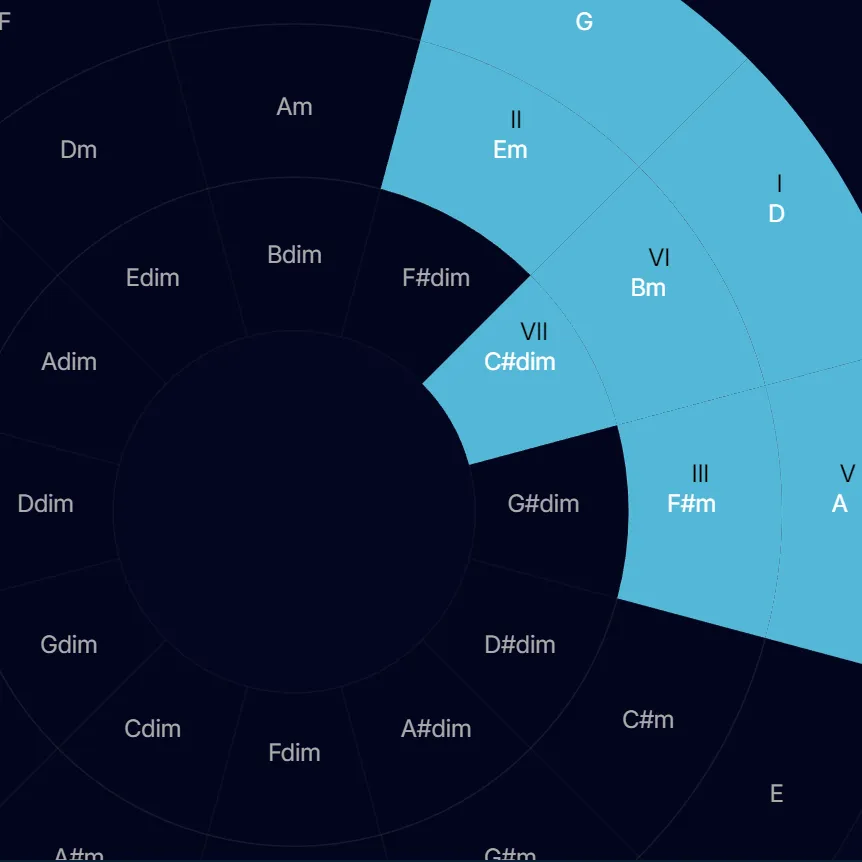
The Circle of Fifths maps key relationships.
It shows:
- Closely related keys
- Shared accidentals
- Logical transitions
Advantages
- Visualizes safe modulations
- Shows common chords
- Helps plan key travel
- Avoids random jumps
Practical Example
Starting in C:
C → G → D → A → E
Each step adds energy.
Or:
C → F → Bb → Eb
Each step darkens the mood.
8. Modulation in Different Genres
Classical
- Structured modulations
- Development sections
- Sonata form
Jazz
- Frequent key changes
- ii–V chains
- Rapid modulations
Pop
- Chorus key lifts
- Simple transitions
- Emotional emphasis
Rock / Metal
- Modal shifts
- Parallel keys
- Unexpected jumps
Film Music
- Extreme modulation
- Emotional manipulation
- Narrative support
Yes, manipulation. That’s the job.
9. Practice Exercises
Exercise 1: Analyze Songs
Pick a song and mark:
Key → Pivot → New Key
Do this weekly.
Exercise 2: Write a Modulation
Write:
C → G → D
Using only pivot chords.
Exercise 3: Pop Key Change
Create:
Verse: C Chorus: D
Using A7 as bridge.
Exercise 4: Guitar Drill
Practice modulating through:
- All keys
- Same progression
- Different positions
Example:
I – V – vi – IV in all 12 keys
This builds real control.
10. Common Mistakes
❌ Random Modulation
If it has no purpose, it sounds fake.
❌ Overusing Key Lifts
Too many = cheap effect.
❌ Weak Preparation
No dominant = weak arrival.
❌ Ignoring Melody
Your harmony modulated. Your melody didn’t. Now it sounds lost.
Conclusion
Modulation is musical storytelling.
It allows you to:
- Build long-form structure
- Control emotional flow
- Keep listeners engaged
- Elevate simple progressions
When you master modulation, you stop looping ideas and start developing them.
You’re no longer stacking chords.
You’re moving through space.
Learn the paths.
Control the journey.
Make every key change matter.