· Music Theory · 4 min read
The Melodic Minor Scale History, Construction, and Uses
Explore the melodic minor scale in classical, jazz, and modern music. Learn its historical origins, ascending and descending forms, harmonic applications, modes, and real musical examples.

The Melodic Minor Scale: History, Construction, Uses, and Musical Examples
The melodic minor scale is one of the most powerful and misunderstood tools in Western music. Originally created to solve melodic problems in classical composition, it later evolved into a complete harmonic system in jazz and modern music.
Unlike the natural and harmonic minor scales, the melodic minor exists in two conceptual frameworks:
- A direction-dependent scale in classical music
- A fixed, symmetrical scale in jazz and contemporary harmony
Understanding both perspectives is essential to using it musically instead of mechanically.
1. Historical Context of the Melodic Minor Scale
The melodic minor scale originated during the Baroque period, when composers encountered a melodic limitation in the harmonic minor scale.
The augmented second between the minor sixth and major seventh of the harmonic minor scale was considered awkward, especially in vocal music. To smooth ascending melodies, composers raised both degrees by a semitone.
By the Classical period, this practice became standardized:
- Ascending lines used raised 6th and 7th degrees
- Descending lines reverted to the natural minor scale
This flexible treatment can be heard clearly in the works of Mozart, Haydn, and Beethoven.
In the 20th century, jazz musicians redefined the melodic minor scale as a fixed structure, used identically ascending and descending. This reinterpretation unlocked a complete modal and harmonic system still central to jazz education today.
2. Construction: Ascending vs. Descending Forms
Ascending Melodic Minor (Classical)
- Interval Formula:
1 – 2 – b3 – 4 – 5 – 6 – 7 – 1- Example in C: C - D - Eb - F - G - A - B - C
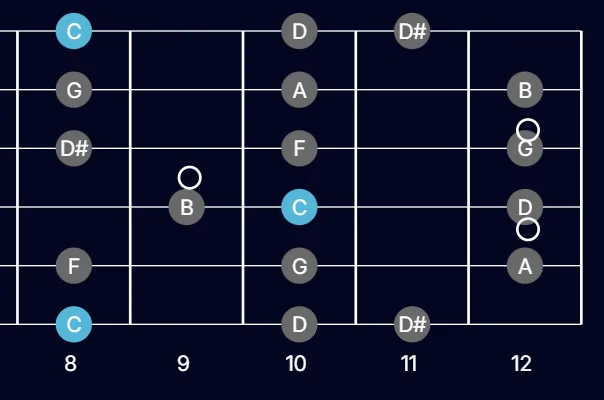
Used primarily for ascending melodic motion and strong cadential pull.
Descending Melodic Minor (Classical)
- Interval Formula:
1 – b7 – b6 – 5 – 4 – b3 – 2 – 1- Example in C: C - Bb - Ab - G - F - Eb - D - C
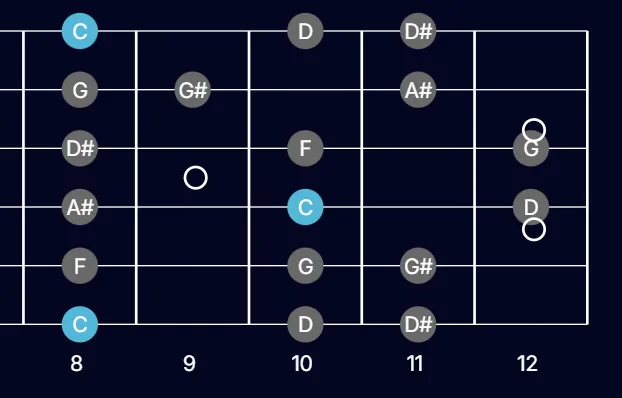
This restores the darker color of the natural minor scale.
Modern / Jazz Melodic Minor
In jazz, the melodic minor scale is treated as direction-independent.
- Formula: 1 - 2 - b3 - 4 - 5 - 6 - 7
This version is the foundation for all melodic minor modes.
3. Chords Derived from the Melodic Minor Scale
Using C melodic minor:
| Degree | Chord Quality | Example |
|---|---|---|
| I | minor-major 7 | Cm(maj7) |
| II | dominant 7 | D7 |
| III | augmented major 7 | Ebmaj7(#5) |
| IV | dominant 7 | F7 |
| V | dominant 7 | G7 |
| VI | half-diminished | Am7(b5) |
| VII | diminished | Bdim7 |
These chords are staples in jazz, fusion, film scoring, and modern composition.
4. Modes of the Melodic Minor Scale
The melodic minor scale generates seven distinct modes, each with a specific harmonic function.
| Mode | Degree | Formula | Common Use |
|---|---|---|---|
| Melodic Minor | I | 1 2 b3 4 5 6 7 | Minor tonic |
| Dorian b2 | II | 1 b2 b3 4 5 6 b7 | Minor with tension |
| Lydian Augmented | III | 1 2 3 #4 #5 6 7 | Floating major |
| Lydian Dominant | IV | 1 2 3 #4 5 6 b7 | Dominant without resolution |
| Mixolydian b6 | V | 1 2 3 4 5 b6 b7 | Blues / fusion |
| Locrian #2 | VI | 1 2 b3 4 b5 b6 b7 | Half-diminished |
| Altered (Super Locrian) | VII | 1 b2 #2 3 b5 #5 b7 | Altered dominants |
This is why melodic minor is considered a complete harmonic system, not just a scale.
5. Real Harmonic Applications and Resolutions
Altered Dominant Resolution
Over a G7alt resolving to Cm:
- Use Ab melodic minor over G7
- Resolve to C minor
Example line: Ab - Bb - B - Db - Eb - F - G → C
Lydian Dominant Usage
Over F7 resolving to Bbmaj7:
- Use C melodic minor
- Emphasize #11 (B)
This avoids the predictable Mixolydian sound.
6. Applications by Genre
Classical Music
- Directional melodic shaping
- Strong cadential pull
- Expressive contrast in minor keys
Examples:
- Mozart – Requiem
- Beethoven – Pathétique Sonata
Jazz and Fusion
- Altered dominants
- Modal interchange
- Extended harmony and substitutions
Essential for modern jazz improvisation.
Rock and Metal
- Neoclassical phrasing
- Dramatic melodic tension
- Smooth minor-to-dominant transitions
Notable users:
- Marty Friedman
- Jason Becker
- John Petrucci
7. Practice Exercises (Advanced)
- Play melodic minor in all keys using the modern fixed form
- Isolate each mode and improvise over its target chord
- Practice resolving altered dominants into minor tonics
- Write a short progression using only melodic minor harmony
Visualizing the Melodic Minor Scale
To truly understand the melodic minor scale and its modes, it helps to visualize them across the fretboard.
You can explore the melodic minor scale in every key, position, and tuning using the Guitar Scale Generator:
👉 https://guitart.blog/guitar-scale-generator
This allows you to instantly switch between modes, keys, and tonal centers, making practice and composition far more intuitive.
Conclusion
The melodic minor scale is no longer just a historical workaround. It is a core language of modern harmony, bridging classical voice-leading and contemporary improvisation.
Mastering it means gaining access to richer chords, stronger resolutions, and a deeper understanding of tonal gravity. Used with intention, it transforms how you hear and write music.