· Music Theory · 5 min read
Functional Harmony Tonic, Dominant, and Subdominant Functions Explained
Learn how tonic, dominant, and subdominant functions shape music, including substitutions, secondary dominants, passing chords, and practical progressions.
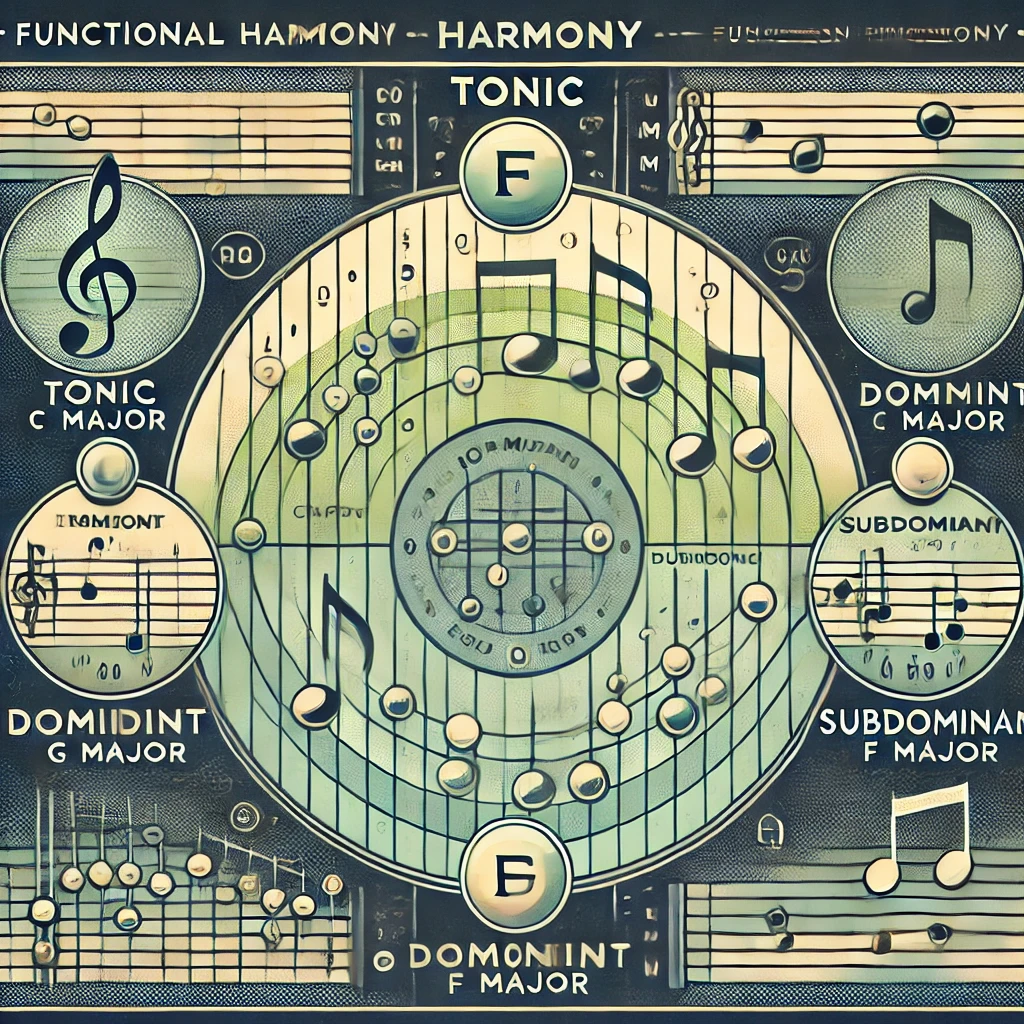
Functional Harmony: Tonic, Dominant, and Subdominant Functions
Functional harmony is the system that explains why chord progressions feel logical, emotional, and satisfying instead of random. Rather than seeing chords as isolated shapes on a fretboard or keyboard, this approach assigns each chord a specific role inside a key.
These roles create the invisible forces of music:
- Tension
- Movement
- Resolution
- Direction
Think of functional harmony as musical gravity. In this guide, we’ll explore the three main harmonic functions—Tonic, Subdominant, and Dominant—and how to use them to write better progressions.
1. The Three Main Harmonic Functions
Every tonal song is built around a balance of three forces. Almost every popular progression is just a creative way of moving between them.
| Function | Emotional Role | Purpose in a Song |
|---|---|---|
| Tonic | Rest, home, resolution | Provides stability. Where the song feels “finished.” |
| Subdominant | Movement, transition | The journey. Moves away from home and prepares the tension. |
| Dominant | Expectation, climax | Creates maximum tension that begs to resolve back to the Tonic. |
2. Tonic Function: The Musical “Home”
The tonic represents stability and rest. When a progression lands on a tonic chord, your ear feels a sense of relief. It is the center of gravity.
Scale Degrees & Chords (Example in C Major)
- Primary Tonic (I): C Major
(C - E - G) - Substitute Tonics (vi, iii): Am
(A - C - E)and Em(E - G - B)
Notice how C Major and A minor share two notes (C and E). This is why they can substitute for one another while maintaining that “stable” feeling.
Usage in Songwriting
- Starting a progression to establish the key.
- Ending phrases or choruses to give a sense of finality.
🎧 Song Example: “Let It Be” by The Beatles heavily anchors itself on the I chord (C major) and the vi chord (A minor) to maintain its comforting, stable feel.
3. Subdominant Function: The Journey
The subdominant sits comfortably between stability and tension. It pulls you away from the tonic without being overly aggressive. Its main job is to prepare the ear for the dominant.
Scale Degrees & Chords (Example in C Major)
- Primary Subdominant (IV): F Major
(F - A - C) - Substitute Subdominant (ii): Dm
(D - F - A)
Usage in Songwriting
- Expanding the verse.
- Creating a wandering, floating feeling (many modern pop songs loop I and IV endlessly).
- Setting up the pre-chorus.
🎧 Song Example: “Dreams” by Fleetwood Mac is famously built almost entirely on subdominant-feeling chords (Fmaj7 to G), creating a perpetual sense of floating without ever fully resolving.
4. Dominant Function: Creating Tension
The dominant is responsible for tension. It needs to resolve. Ignoring a dominant chord feels like leaving a sentence unfinished.
This tension comes from a highly unstable interval called a tritone hidden inside the dominant 7th chord, which acts like a musical magnet pulling toward the tonic.
Scale Degrees & Chords (Example in C Major)
- Primary Dominant (V): G Major or G7
(G - B - D - F) - Substitute Dominant (vii°): B diminished
(B - D - F)
Usage in Songwriting
- The end of a bridge right before the final chorus.
- Strong cadences to forcefully end a section.
- Creating an undeniable climax.
🎧 Song Example: “Hotel California” by the Eagles uses a massive dominant V chord (F#7 in the key of B minor) to create intense, unavoidable tension right before the iconic chorus drops.
5. Basic Functional Progressions
Here are classic functional templates used everywhere. Read them as a journey: Home ➔ Journey ➔ Tension ➔ Home.
The Classical / Pop Standard
Moves from stability, to movement, to tension, to resolution.
- Roman Numerals:
I – IV – V – I - In C Major:
C – F – G – C
The Jazz / R&B Standard (ii-V-I)
Uses the minor subdominant for a smoother, slightly jazzier pull into the dominant.
- Roman Numerals:
ii – V – I - In C Major:
Dm – G – C
The 50s Doo-Wop Progression
Uses the relative minor (vi) to extend the tonic feeling before moving to the subdominant.
- Roman Numerals:
I – vi – IV – V - In C Major:
C – Am – F – G
6. Harmonic Substitutions and Advanced Tricks
Once you understand functions, you can swap chords to change the color of a song without changing its structure.
6.1 Relative Substitution (Diatonic)
You can swap a chord for its relative minor/major because they share a function.
- Standard:
C – F – G(Tonic - Subdominant - Dominant) - Substituted:
Am – Dm – G(Still Tonic - Subdominant - Dominant, but now dark and moody)
6.2 Secondary Dominants
These are dominant chords from outside the key used to target a chord other than the root. It temporarily makes another chord feel like “home.”
- Example:
C – A7 – Dm – G7 - The A7 doesn’t belong in C major. It is the dominant (V) of Dm. It creates intense, temporary forward momentum.
6.3 Tritone Substitution (Jazz Secret)
A dominant chord can be replaced by a dominant 7th chord exactly three whole steps (a tritone) away. They share the same tension notes.
- Standard:
Dm7 – G7 – Cmaj7 - Substituted:
Dm7 – Db7 – Cmaj7 - Notice the incredibly smooth, chromatic bassline descending: D ➔ Db ➔ C.
7. Passing Chords
Passing chords don’t have a strong functional role; they exist purely to connect main chords smoothly.
- Chromatic Passing Chords: Moving by a half-step to connect two functional chords.
- Example:
C ➔ C#dim ➔ Dm
- Example:
- Approach Chords: Playing a chord one half-step above or below your target chord right before you land on it.
- Example:
Am ➔ Ab ➔ G
- Example:
8. Common Mistakes to Avoid
- ❌ Overusing the Tonic: If you never leave home, there is no journey. The song will feel stagnant.
- ❌ Avoiding the Dominant: Modern pop often fears the V chord, relying only on IV. While this sounds modern, it can make a song feel like it has no real climax.
- ❌ Random Substitutions: If you swap a Dominant (V) for a Subdominant (IV) randomly, you break the functional flow. Always substitute within the same function.
Conclusion
Functional harmony is the hidden wiring behind most Western music. When you understand how tonic, subdominant, and dominant interact, you stop guessing on the fretboard and start composing with intention.
Mastering this gives you:
- Progressions that make emotional sense.
- Stronger, more logical melodies.
- The ability to reharmonize any song.
It’s not about memorizing thousands of chords. It’s about understanding musical gravity. Learn the forces, and then you can bend them to your will.