· Music Theory · 13 min read
Japanese Scales for Guitar Hirajoshi, Insen, Iwato, Kumoi, Yo & More
Explore Japanese scales for guitar with interval formulas, note examples, musical characteristics, historical context, and practical applications in metal, fusion, and modern composition.

Japanese Scales for Guitar: History, Formulas, and Applications
Japanese music features distinctive melodic traditions shaped by instrumental tunings, regional styles, and different approaches to pitch and melody. Pentatonic scales, which contain five notes per octave, are particularly useful for exploring some of these sounds.
In modern guitar education, scales such as Hirajoshi, Insen, Iwato, Kumoi, Miyako-bushi, and Yo are popular among guitarists and composers looking for melodies that sound mysterious, reflective, tense, or distinctly different from conventional major and minor patterns.
However, these names do not always correspond to a single, universally accepted scale formula. Some refer to modern Western interpretations of Japanese musical patterns, while others are associated with traditional Japanese tunings or theoretical systems.
This guide focuses on practical formulas for guitar while distinguishing modern scale terminology from its traditional context.
1. A Brief History of Japanese Scales
Japanese musical traditions developed through centuries of cultural exchange and independent evolution. Chinese musical systems influenced Japanese court music, while regional folk traditions, Buddhist ceremonial music, and instrumental genres developed their own characteristic melodic practices.
In traditional Japanese music, the koto, a long zither, is associated with distinctive tunings such as hirajōshi and kumoijōshi. The shamisen and shakuhachi also feature characteristic melodic techniques, including pitch inflections and expressive bends that cannot always be represented accurately by a fixed Western scale.
An important distinction is that a traditional Japanese tuning is not necessarily identical to the concept of a scale used in modern guitar instruction. Western music theory often extracts five notes from a tuning, assigns a tonic, and describes the resulting pattern through interval formulas.
This approach is useful for composition and improvisation, but it simplifies some aspects of the original musical context.
Today, Japanese-inspired pentatonic patterns appear in film scores, video game soundtracks, anime music, jazz fusion, progressive metal, and neoclassical guitar.
2. Japanese Scales: Comparison Table
The following table uses common modern guitar-theory definitions. All examples are transposed to C so that their interval structures can be compared directly.
The semitone column shows the distance between consecutive notes, including the final interval back to the octave.
| Scale | Formula | Semitone steps | Notes in C |
|---|---|---|---|
| Hirajoshi | 1, 2, b3, 5, b6 | 2–1–4–1–4 | C, D, Eb, G, Ab |
| In / Miyako-bushi | 1, b2, 4, 5, b6 | 1–4–2–1–4 | C, Db, F, G, Ab |
| Insen | 1, b2, 4, 5, b7 | 1–4–2–3–2 | C, Db, F, G, Bb |
| Iwato | 1, b2, 4, b5, b7 | 1–4–1–4–2 | C, Db, F, Gb, Bb |
| Kumoi, common guitar convention | 1, 2, b3, 5, 6 | 2–1–4–2–3 | C, D, Eb, G, A |
| Yo | 1, 2, 4, 5, 6 | 2–2–1–2–2 | C, D, F, G, A |
| Yonanuki major | 1, 2, 3, 5, 6 | 2–2–3–2–3 | C, D, E, G, A |
| Yonanuki minor | 1, b3, 4, 5, b7 | 3–2–2–3–2 | C, Eb, F, G, Bb |
Important terminology note: Kumoi is used inconsistently in modern scale references. The formula shown above is a common guitar-oriented definition. Kumoijōshi, by contrast, is a traditional koto tuning associated with the In/Miyako-bushi family. These terms should not automatically be treated as interchangeable.
3. Hirajoshi Scale
The Hirajoshi scale is one of the most popular Japanese-inspired scales among guitarists. It is frequently used for melodic passages, arpeggios, lead guitar, and compositions that need a minor-like but less conventional sound.

Formula: 1, 2, b3, 5, b6
Semitone steps: 2–1–4–1–4
Example in C: C, D, Eb, G, Ab
Characteristics
- The b3 creates a minor-like quality.
- The 2 contrasts with the b3 and provides melodic movement.
- The b6 introduces tension against the tonic and fifth.
- The absence of the 4 and 7 degrees creates a more open melodic framework than a conventional seven-note scale.
Guitar application
Try emphasizing the movement between D and Eb, followed by G and Ab. These relationships create tension without requiring complex harmony.
Hirajoshi works well for melodic sequences, tapped arpeggios, legato lines, and riffs that alternate between open-string drones and fretted notes.
Historically, hirajōshi refers to a standard koto tuning. The formula presented here is the familiar Western guitar interpretation, not a complete description of traditional koto practice.
4. In Scale and Miyako-bushi
The In scale is a central reference point for several Japanese-inspired pentatonic patterns. Miyako-bushi is closely associated with this sound and, in modern guitar references, the two names are frequently used for the same five-note formula.

Formula: 1, b2, 4, 5, b6
Semitone steps: 1–4–2–1–4
Example in C: C, Db, F, G, Ab
Characteristics
- The b2 creates immediate tension above the tonic.
- The 4 and 5 establish a strong structural framework without a conventional third.
- The b6 adds another semitone relationship against the fifth.
- The absence of a third makes the scale less explicitly major or minor.
Guitar application
Focus on the movements C–Db and G–Ab. Both are semitone relationships that can create a distinctive melodic identity.
For metal, combine low-string pedal notes with short phrases built around the b2. Alternating the tonic and b2 can create a tense riff, while sustained fourths and fifths provide contrast.
Is In the same as Miyako-bushi?
In modern scale charts, the formula above is commonly labeled both In and Miyako-bushi. In Japanese music theory, however, Miyako-bushi also refers to a characteristic tetrachord and its associated melodic tradition. Its historical meaning is more specific than a simple Western scale label.
5. Insen Scale
The Insen scale is another widely used Japanese-inspired scale for guitar. Its most common modern Western formula differs from the In scale by using b7 instead of b6.
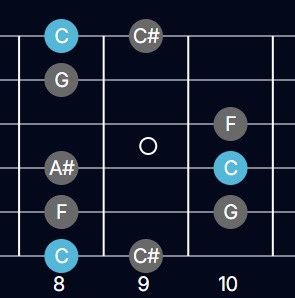
Formula: 1, b2, 4, 5, b7
Semitone steps: 1–4–2–3–2
Example in C: C, Db, F, G, Bb
Characteristics
- The b2 creates a tense relationship with the tonic.
- The 4 and 5 provide a stable melodic framework.
- The b7 introduces a blues-like or modal color without adding a conventional third.
- Compared with the In scale, the b7 produces a different melodic destination and changes the final interval pattern.
Guitar application
Experiment with C–Db, F–G, and G–Bb. These movements can create melodies that sound tense without relying on chromatic runs or dense dissonant chords.
Insen is especially useful for single-note lead phrases, melodic sequences over pedal tones, and riffs that alternate between a low tonic and higher notes.
The formula above is the common Western theoretical representation. Traditional Japanese musical practice involves more than the notes of a five-note scale.
6. Iwato Scale
The Iwato scale is known in modern guitar theory for its dark, tense sound. Its characteristic b2 and b5 create a particularly angular interval structure.

Formula: 1, b2, 4, b5, b7
Semitone steps: 1–4–1–4–2
Example in C: C, Db, F, Gb, Bb
Characteristics
- The b2 adds immediate tension against the tonic.
- The b5 creates a tritone relationship with the root.
- The b7 adds a darker modal color.
- The lack of a third leaves the tonality ambiguous.
Guitar application
Emphasize C–Db and F–Gb to highlight the semitone relationships. The F–Gb movement is particularly effective when played as a short repeated motif.
For metal, Iwato can be used for dissonant melodic riffs, tremolo-picked lines, diminished-sounding passages, and phrases that alternate between a low pedal tone and upper-register tension.
Use the b5 deliberately. If every note is accented equally, the scale loses its distinctive interval hierarchy and simply sounds like a collection of unrelated notes.
7. Kumoi Scale
The Kumoi scale is commonly presented in modern guitar education as a five-note scale with a minor-like character and a natural sixth.

Formula used in this guide: 1, 2, b3, 5, 6
Semitone steps: 2–1–4–2–3
Example in C: C, D, Eb, G, A
Characteristics
- The b3 gives the scale a minor-like quality.
- The natural 6 creates a brighter color than the b6 in the Hirajoshi formula.
- The absence of the fourth and seventh degrees leaves space for open melodic phrasing.
- Its mixture of minor and major intervals makes it useful for melodies that shift between introspective and uplifting moods.
Guitar application
Compare the final two notes of Hirajoshi and Kumoi:
- Hirajoshi: G–Ab
- Kumoi: G–A
The semitone in Hirajoshi becomes a whole tone in this Kumoi convention. That single change can substantially alter a melody’s character.
Terminology warning: Some references use Kumoi for different five-note collections, including patterns related to the In family. Always verify the formula when using a chart, lesson, or tab.
8. Yo Scale
The Yo scale is a traditional Japanese pentatonic pattern often associated with folk melodies and a more open, bright sound.

Formula: 1, 2, 4, 5, 6
Semitone steps: 2–2–1–2–2
Example in C: C, D, F, G, A
Characteristics
- The scale contains no third, avoiding an explicit major or minor triad.
- The natural sixth contributes to its relatively open sound.
- The fourth and fifth provide stable melodic reference points.
- Its notes can support simple, memorable melodies without conventional leading-tone resolutions.
Guitar application
Use the scale for melodic riffs, clean guitar passages, arpeggios, and contrasting sections in heavier compositions.
Over a C pedal tone, experiment with D, F, G, and A rather than treating the pattern as a conventional C major scale. The goal is to build phrases around the pentatonic collection’s characteristic relationships.
9. Yonanuki Major and Minor
Yonanuki scales are Japanese pentatonic patterns that omit the fourth and seventh degrees of the major scale, or the corresponding degrees in a minor context.
They are useful additions to a guitar reference because they demonstrate that Japanese-inspired pentatonic music is not limited to dark or exotic-sounding scales.
Yonanuki major
Formula: 1, 2, 3, 5, 6
Semitone steps: 2–2–3–2–3
Example in C: C, D, E, G, A
This collection corresponds to the familiar Western major pentatonic scale. It is suitable for bright melodies, folk-like phrases, and more consonant passages.
Yonanuki minor
Formula: 1, b3, 4, 5, b7
Semitone steps: 3–2–2–3–2
Example in C: C, Eb, F, G, Bb
This collection corresponds to the familiar Western minor pentatonic scale. It works well for blues, rock, metal, and melodic lead playing.
The term yonanuki refers to omitting the fourth and seventh degrees from a seven-note diatonic framework. It is useful to distinguish this concept from the more specific interval patterns associated with Insen or Iwato.
10. How to Use Japanese Scales in Metal
Japanese-inspired scales can work particularly well in metal because they offer compact interval collections that are easy to turn into memorable riffs and melodic motifs.
The key is not to play the scale from beginning to end. Instead, identify two or three characteristic intervals and build musical ideas around them.
Use the b2 for tension
The movement between 1 and b2 is one of the most recognizable features of several Japanese-inspired scales.
Try alternating a low C pedal tone with Db on a higher string. Change the rhythm, articulation, and octave while keeping the pitch relationship consistent.
This works well with palm-muted riffs, tremolo picking, and short chromatic-sounding motifs.
Use the b5 for angular melodies
Iwato contains the b5, which creates a tritone against the tonic.
This interval can produce a more dissonant sound than the natural fifth used in Insen and the In scale.
Try a phrase built around C, Db, F, and Gb. Repeat the motif with different rhythmic accents rather than adding notes indiscriminately.
Use the natural sixth for contrast
Hirajoshi contains b6, while the Kumoi convention used here contains natural 6.
That difference creates two distinct melodic possibilities:
- G–Ab in Hirajoshi emphasizes a semitone and a tighter sense of tension.
- G–A in Kumoi creates a wider interval and a more open sound.
Use these differences to change the character of a lead phrase without completely changing its melodic framework.
Combine pedal tones with upper-register phrases
A low tonic pedal can provide continuity while the upper notes create tension.
For example, hold or repeat a low C while moving through Db, F, G, and Ab. The repeated tonic acts as an anchor, allowing the upper melody to sound tense without requiring elaborate chord changes.
This technique can be effective in progressive metal, thrash metal, instrumental guitar music, and soundtrack-style compositions.
Control the phrasing
The scale alone does not determine the mood. Rhythm, articulation, dynamics, note duration, and melodic emphasis are equally important.
A short, aggressively picked motif can sound threatening, while the same notes played slowly with sustained bends can sound reflective.
Japanese-inspired phrasing can also benefit from space between motifs. Repetition and variation are often more effective than continuously running through all five notes.
11. Japanese Scales in Contemporary Music
Japanese-inspired melodic ideas appear in numerous contemporary styles, including instrumental rock, neoclassical metal, progressive metal, film music, and video game soundtracks.
Guitarists Marty Friedman and Jason Becker, particularly through their work with Cacophony and their solo careers, are useful listening references for studying unusual pentatonic melodies, exotic interval combinations, and expressive phrasing.
Cacophony: “Ninja”
“Ninja” is a useful listening reference for studying Japanese-inspired melodic gestures and neoclassical guitar phrasing.
Do not assume that every phrase in the track belongs to one pentatonic scale. Analyze the actual notes, bass movement, and harmony before assigning a specific formula.
Megadeth: “Tornado of Souls”
Marty Friedman’s solo in “Tornado of Souls” is another useful reference for studying expressive melodic phrasing, unusual note choices, bends, and the way a lead line can create tension without sounding like a mechanical scale exercise.
The solo should not be treated as a strictly Japanese-scale composition. Its value here is as an example of phrasing and melodic expression that can inspire similar experiments.
12. Practical Guitar Exercises
Use the following exercises to explore the scales without reducing them to ascending and descending patterns.
Exercise 1: Compare Hirajoshi and Kumoi
Play both scales over a C pedal tone.
Hirajoshi: C, D, Eb, G, Ab
Kumoi: C, D, Eb, G, A
Keep the first four notes identical and change only the final note. Listen to how the change from b6 to natural 6 affects the melody.
Exercise 2: Build tension with Iwato
Use the notes C, Db, F, Gb, and Bb.
Create a short four-note motif emphasizing C–Db and F–Gb. Repeat it at different octaves and vary the rhythm.
Avoid resolving every phrase immediately to C. Let the dissonant intervals remain exposed.
Exercise 3: Compare Insen and In
Insen: C, Db, F, G, Bb
In: C, Db, F, G, Ab
Change only the final note. The difference between Ab and Bb affects the phrase’s direction and its relationship with the tonic.
Exercise 4: Write a riff using a pedal tone
Choose a low C or another convenient root. Repeat it rhythmically while using three or four upper notes from one scale.
Start with a simple rhythm, then add rests, accents, palm muting, and variations in note duration.
The objective is to create a recognizable riff, not to demonstrate that all five notes have been memorized.
13. Final Thoughts
Japanese scales offer guitarists a compact way to explore melodic colors outside familiar major, minor, and blues vocabulary. Hirajoshi provides a minor-like framework, Insen emphasizes the b2 and b7, Iwato introduces a tritone, Kumoi offers a contrasting natural sixth in one common guitar convention, and Yo provides a more open pentatonic sound.
Their effectiveness comes from the way individual intervals interact with the tonic, rhythm, and musical context.
For practical composition, memorize both the scale formula and the sound of its characteristic intervals. Treat the names as useful reference labels, not as guarantees of a single historical definition.
Most importantly, write phrases rather than scale exercises. A small group of notes with a clear rhythmic identity will usually produce a stronger musical result than running through an entire pattern at high speed.