· Music Theory · 5 min read
Rhythm in Music Characteristics, Elements, and Its Importance
Discover what rhythm truly is in music. Learn about beats, meter, tempo, accents, syncopation, subdivisions, and how rhythm shapes emotion, style, and movement.
Rhythm in Music: Characteristics, Elements, and Its Importance
Rhythm is one of the essential foundations of music. It governs how sound unfolds over time, organizing notes and silences into patterns that create movement, tension, and release.
While melody gives music its identity and harmony provides color, rhythm gives it structure and motion. Without rhythm, music would lose direction, energy, and coherence.
What Is Rhythm?
Rhythm is the arrangement of sounds and silences in time. It is created through the interaction of beats, tempo, accents, and note durations.
At its core, rhythm answers a simple question:
When does each sound happen?
Key Characteristics of Rhythm
1. Beat
The beat is the basic unit of time in music. It is the steady pulse you instinctively tap your foot to.
- Example: In “We Will Rock You” by Queen, the iconic “boom-boom-clap” clearly establishes the beat.
- In most popular music, beats are grouped into sets of four.
The beat acts as the reference point for performers and listeners alike.
2. Meter (Measure)
Meter organizes beats into repeating groups called measures (or bars). It determines how beats are structured and perceived.
Meter is expressed as a time signature:
- 2/4 (Binary Meter) – Common in marches.
Example: “Radetzky March”. - 3/4 (Ternary Meter) – Typical of waltzes.
Example: “The Blue Danube”. - 4/4 (Quaternary Meter) – The most common meter in popular music.
Example: “Shape of You” by Ed Sheeran. - 5/4 or 7/8 (Irregular Meters) – Found in jazz and progressive music.
Example: “Take Five” by Dave Brubeck (5/4).
Each meter creates a different sense of balance and movement.
3/4 feels circular and flowing.
4/4 feels stable and grounded.
Odd meters feel asymmetrical and often more complex.
3. Tempo
Tempo defines how fast the beat moves. It is measured in BPM (Beats Per Minute).
- Adagio (slow) – Under 60 BPM
Example: “Clair de Lune” by Debussy. - Andante / Moderato (moderate) – 60–120 BPM
Example: “Imagine” by John Lennon. - Allegro / Presto (fast) – 120+ BPM
Example: “Don’t Stop Me Now” by Queen.
Tempo shapes emotional perception.
Slow tempos often feel reflective or intimate.
Fast tempos tend to feel energetic or urgent.
Fundamental Elements of Rhythm
4. Note Duration
Rhythm depends on how long each note or silence lasts.
Common rhythmic values include:
- Whole notes
- Half notes
- Quarter notes
- Eighth notes
- Sixteenth notes
Longer durations create space and stability.
Shorter durations create motion and intensity.
- Example (long durations): The sustained chords at the beginning of “Let It Be” by The Beatles.
- Example (short durations): The fast guitar riff in “Sweet Child O’ Mine” by Guns N’ Roses.
5. Subdivision
Subdivision is how beats are divided internally.
- Binary subdivision: Dividing a beat into two equal parts (common in rock and pop).
- Ternary subdivision: Dividing a beat into three equal parts (common in blues and swing).
Subdivision greatly affects the feel:
- Straight eighth notes feel direct and even.
- Swing eighth notes feel elastic and groovy.
6. Accents
An accent emphasizes a particular note or beat.
In 4/4 meter:
- Beat 1 is typically strong.
- Beat 3 is moderately strong.
However, many styles shift accents intentionally:
- “Billie Jean” by Michael Jackson emphasizes a tight groove centered around strong pulse control.
- Funk and jazz frequently place accents in unexpected positions to create tension.
Accents give rhythm character and direction.
7. Rhythmic Figures
Rhythmic figures are recurring patterns of notes and rests that define a musical style.
Syncopation
Syncopation occurs when emphasis is placed on weak beats or off-beats.
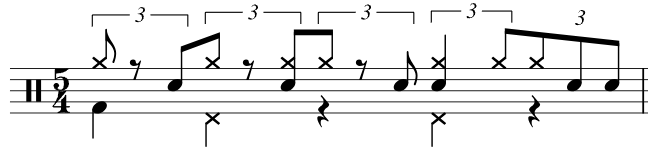
Example:
“Take Five” by Dave Brubeck uses syncopation within a 5/4 meter, creating a distinctive and sophisticated groove.
Off-Beats
Off-beats occur between the main beats, creating a sense of forward motion or lift.

Example:
In “I Want to Hold Your Hand” by The Beatles, rhythmic emphasis between beats adds energy and drive.
Triplets
Triplets divide a beat into three equal parts.

Example:
“Piano Man” by Billy Joel features triplet-based rhythms that create a rolling, fluid feel.
The Importance of Rhythm in Music
1. Structural Organization
Rhythm provides the temporal framework that holds melody and harmony together. Without it, music would feel unstructured.
2. Stylistic Identity
Genres are often defined by rhythm:
- Rock – Strong backbeat (snare on beats 2 and 4).
Example: “Back in Black” by AC/DC. - Salsa – Structured around the clave pattern.
Example: “Oye Como Va” by Tito Puente. - Jazz – Swing feel and syncopation.
Example: “So What” by Miles Davis.
Rhythm often matters more than harmony when identifying a genre.
3. Emotional Impact
Rhythm shapes emotional perception:
- Slow and sparse rhythms can feel introspective.
Example: “Someone Like You” by Adele. - Fast and dense rhythms can feel energetic.
Example: “Don’t Stop Believin’” by Journey.
4. Physical Connection
Rhythm engages the body. It invites movement, dance, and coordination.
Songs like “Uptown Funk” by Bruno Mars are built around rhythmic groove designed for physical response.
Rhythm Beyond Music
Rhythm exists outside music as well:
- Language – Poetry uses meter and stress patterns.
- Dance – Movement follows rhythmic cycles.
- Nature – Heartbeats, breathing, circadian cycles.
Rhythm is a universal organizing principle of time.
Practical Exercises to Improve Rhythm
- Clap With a Metronome – Practice steady quarter notes at different BPMs.
- Change Subdivisions – Alternate between straight and triplet subdivisions.
- Accent Shifting – Play a simple rhythm and move the accent to different beats.
- Record Yourself – Check consistency and timing accuracy.
- Explore Odd Meters – Try counting 5/4 or 7/8 slowly and steadily.
Conclusion
Rhythm is the engine of music. It organizes time, shapes style, and connects sound to physical movement.
Understanding rhythm deeply improves not only performance but also listening, composing, and improvisation.
Master rhythm, and you master the foundation of music itself.