· Tutorials · 4 min read
Split Coil and Spin-a-Split – Expand Your Guitar's Versatility
Learn how Split Coil and Spin-a-Split wiring work, their tonal differences, advantages, limitations, and how to use them to unlock new sounds from your humbuckers.
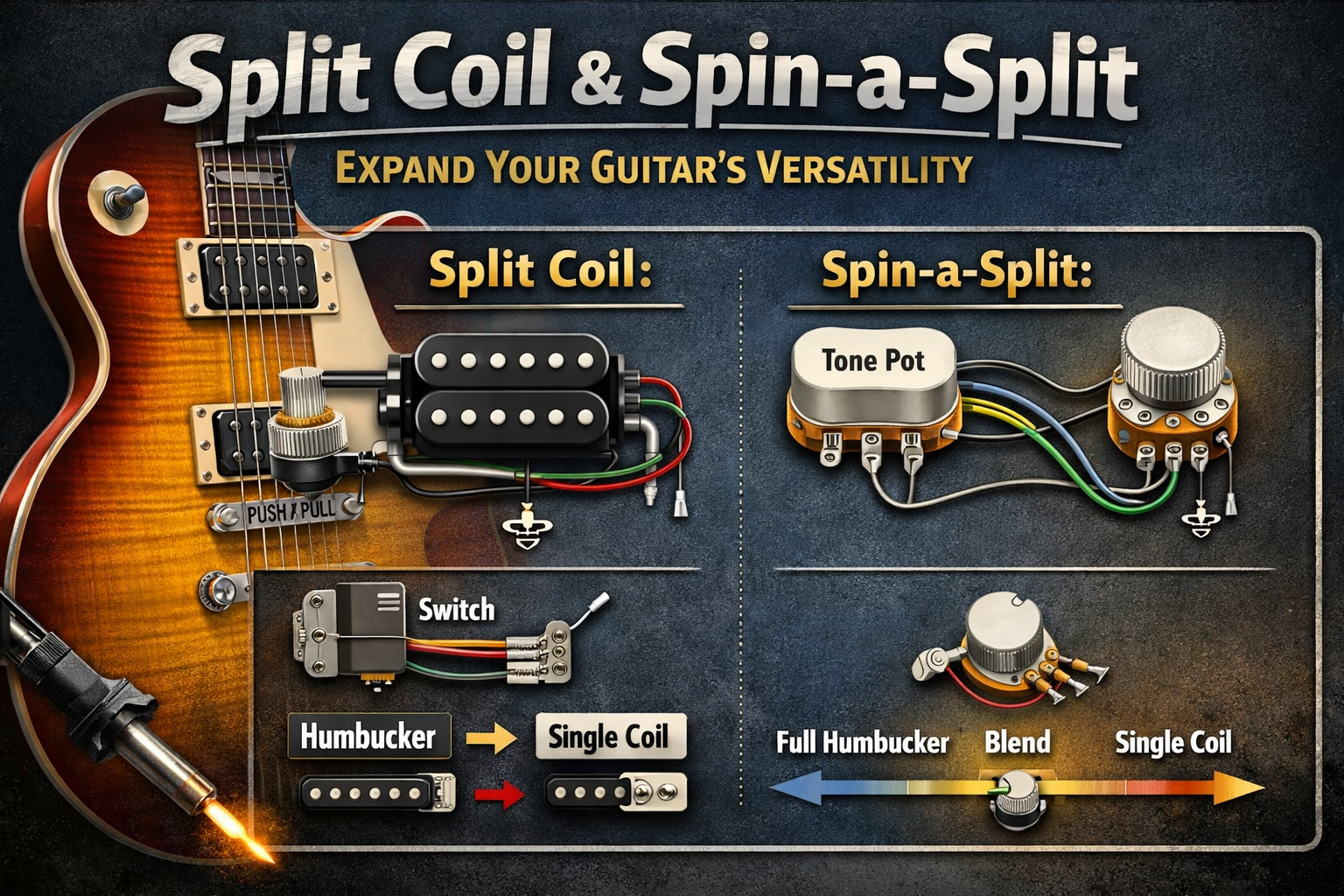
Split Coil and Spin-a-Split – Expand Your Guitar’s Versatility
Modern guitar players often need flexibility. Carrying multiple guitars to cover different tones is expensive, impractical, and honestly unnecessary in many cases.
Split Coil and Spin-a-Split wiring options allow a single guitar equipped with humbuckers to cover a much wider tonal range, moving from thick, high-output sounds to brighter, more articulate tones with minimal hardware changes.
What Is Split Coil?
Split Coil is a wiring modification that allows a humbucker (dual-coil pickup) to operate using only one of its coils. By disabling one coil, the pickup behaves similarly to a single-coil, producing a brighter and leaner sound.
This feature is commonly activated via a switch or push-pull potentiometer.
How Does Split Coil Work?
A humbucker consists of two coils wired together to cancel hum and increase output. When you engage Split Coil:
- One coil is sent to ground
- The other remains active
- Noise cancellation is lost
- Output and low-end response are reduced
The result is a tone that sits somewhere between a traditional single-coil and a full humbucker.
Advantages
- Expanded tonal palette without changing guitars
- Instant switching between thick and bright tones
- Better definition for clean passages and arpeggios
Limitations
- Lower output compared to full humbucker mode
- More noise than humbucker mode
- Not a true single-coil sound due to pickup construction and position
Split Coil is about versatility, not perfect imitation.
How Is Split Coil Activated?
Common control methods include:
-
Push-Pull Potentiometer
Integrated into volume or tone knobs. Clean look, very popular. -
Mini Toggle Switch
Dedicated and easy to identify, but requires drilling. -
Pickup Selector Integration
Used in advanced or proprietary wiring setups. -
Fixed Resistor or Pot-Based Split
Partial splits that reduce output loss.
Installing Split Coil
Required Materials
- Push-pull pot or toggle switch
- Soldering iron and solder
- Pickup wiring diagram (manufacturer-specific)
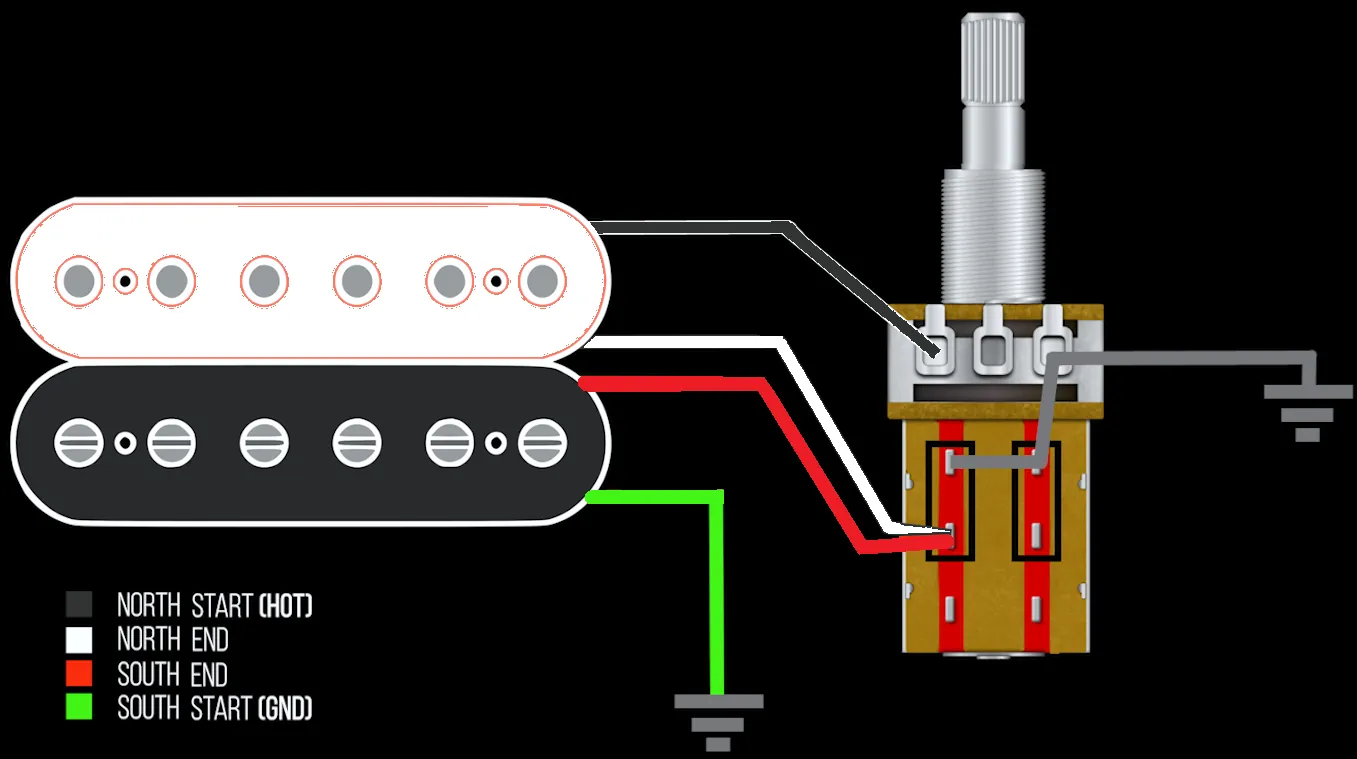
Note:
If your pickup does not have four-conductor wiring, Split Coil is not possible without modifying the pickup itself.
What Is Spin-a-Split?
Spin-a-Split is a variation of coil splitting that replaces the on/off behavior with continuous control using a standard potentiometer.
Instead of fully disabling one coil, Spin-a-Split gradually sends part of one coil’s signal to ground. This creates a smooth transition between humbucker and split tones.
Think of it as a blend knob, not a switch.
How Does Spin-a-Split Work?
- Fully clockwise: full humbucker
- Fully counterclockwise: near single-coil behavior
- Middle positions: hybrid tones with unique character
This allows subtle tonal shaping rather than drastic jumps.
Advantages
- Fine-grained control over brightness and output
- No additional switches
- Unique in-between tones unavailable with standard Split Coil
Trade-offs
- Requires experimentation
- Not ideal for fast switching mid-song
- Slight volume drop across the range
Installing Spin-a-Split
Required Materials
- Standard potentiometer (250 kΩ or 500 kΩ)
- Basic wiring tools
- Optional capacitor for response shaping
Basic Wiring Concept
- Middle lug → coil split wire
- One outer lug → ground
- Other outer lug → left unused or grounded

Potentiometer Value Guide
-
250 kΩ
Smoother sweep, darker response, good for lower-output pickups -
500 kΩ
Brighter response, better for high-output humbuckers
Split Coil vs Spin-a-Split
| Feature | Split Coil | Spin-a-Split |
|---|---|---|
| Control type | On / Off | Continuous |
| Ease of use | Very simple | Requires adjustment |
| Switching speed | Instant | Gradual |
| Tonal flexibility | Moderate | High |
| Best for | Live performance | Studio and tone shaping |
When Should You Use Spin-a-Split?
Spin-a-Split shines when tone nuance matters more than speed.
Ideal styles:
- Jazz – Fine-tune clarity without losing warmth
- Progressive Rock – Adaptive tones across sections
- Ambient / Shoegaze – Blends beautifully with modulation effects
- Studio Recording – Dial exact tones for layered parts
Is Split Coil Right for Your Playing Style?
Split Coil works especially well if you:
- Play multiple genres
- Need both clean and driven tones in one song
- Want clarity without sacrificing humbucker power entirely
Common Use Cases
- Rock / Metal – Humbucker for riffs, split for clean intros
- Blues / Funk – Sharper attack and articulation
- Pop / Country – Cleaner rhythm tones without switching guitars
Conclusion
Split Coil and Spin-a-Split are practical, powerful upgrades that dramatically increase the usefulness of humbucker-equipped guitars.
They do not replace true single-coils.
They do not magically turn your guitar into three instruments.
What they do is give you control, flexibility, and creative options with minimal modification.
If versatility matters to you, these mods are absolutely worth exploring.